Discover the Why Behind Mathematics

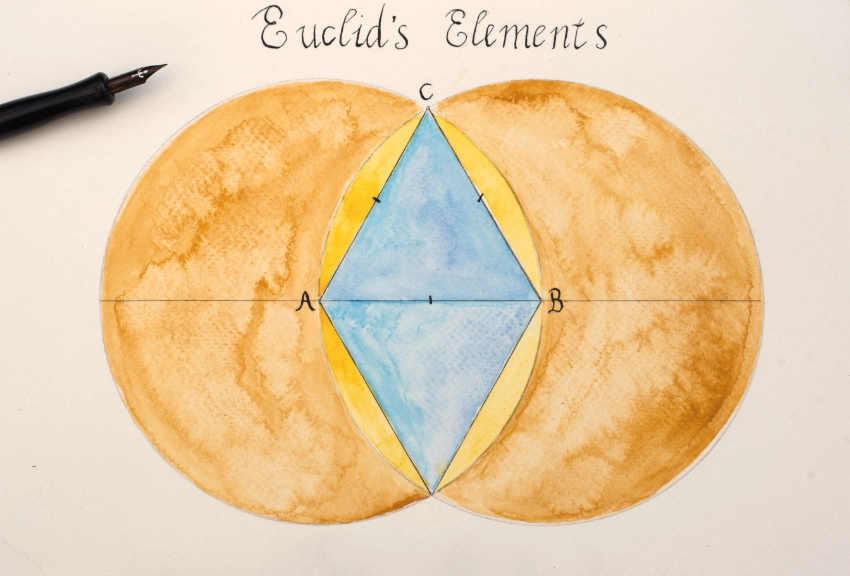
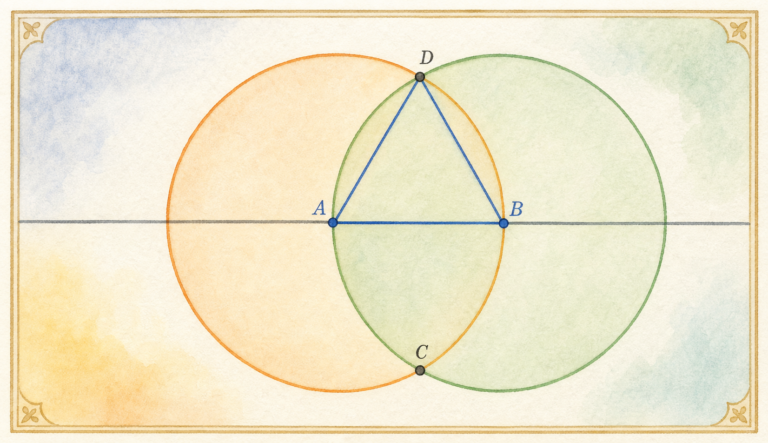
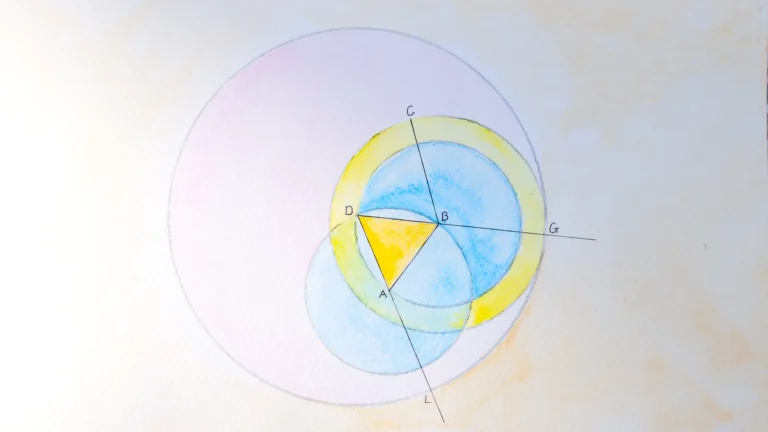
Watercolour geometric construction inspired by Euclid’s Elements

An exploration into the
deeper foundations of mathematics.

It all begins with attention, spatial awareness,
imagination, language and the gradual formation of thought.

From there it becomes the language of
relationship, form, logic, pattern and structure.

Watercolour illustration of a circle, centre and diameter

The Foundations and Vision of Sacred Mathematics

Sacred Mathematics draws its inspiration from the deeper order, harmony and intelligence within existence. Throughout the ages, philosophers and mathematicians have searched for ways to understand the underlying structure of the world around them. In the Pythagorean tradition, number, ratio and harmony were understood as fundamental to the order of the cosmos, while Plato and the later Platonic and Neoplatonic traditions explored the intelligible forms and mathematical relationships underlying the changing world of experience. Other philosophical traditions developed different accounts of this underlying order. Heraclitus spoke of the Logos as a principle of order and intelligibility, an idea that was developed further by the Stoics, while the Hellenistic Jewish philosopher Philo of Alexandria brought the concept of Logos into relationship with Jewish thought. Within early Christianity, the Logos acquired a further and profoundly theological meaning as the eternal divine Word through whom creation comes into being and is made intelligible. Across these traditions the meanings differ considerably, yet there is a recurring recognition that reality possesses an underlying order that the human mind can encounter and seek to understand. Within the mathematical traditions, number, form, proportion and relationship became some of the most powerful ways of investigating that order.

So how does this cosmic understanding of mathematics relate to our ordinary everyday existence? Let’s take a look at how mathematics appears in our daily lives. Mathematical activity begins with a way of seeing the world. It is a kind of awareness. It begins with observation and perception. In our encounter with the space around us, we recognise quantity, shape, movement, position, rhythm, patterns and relationships. Gradually, the mind learns to distinguish what changes from what remains the same. Three stones, three sounds and three people are very different experiences, yet in each case the same numerical relationship is present. By setting aside the particular qualities of the stones, sounds or people and attending only to how many there are, the mind abstracts the concept of three. That underlying structure can then be recognised, named and eventually represented symbolically.

The great mathematicians and philosophers of the past who created the mathematical systems that our present-day understanding of mathematics is built on, had a profound understanding of and insight into these patterns and relationships that remain true beyond the particular objects through which we first encounter them. The underlying structure in language plays an essential role in this process, allowing us to define concepts, express relationships and reason about them with increasing precision.

Over centuries, this search for precision transformed mathematics and logic. The Greeks developed systematic forms of deductive reasoning, while Euclid showed how a mathematical world could be developed from carefully defined concepts, common principles and postulates. Drawing upon centuries of human experience with space, form, measurement and construction, Euclid organised these accumulated insights into a geometric world of points, lines, circles and relationships that could be explored through precise definitions, postulates and reason.

Much later, Gottfried Wilhelm Leibniz asked an extraordinary question: Could reasoning itself be expressed through a precise symbolic language and handled almost like calculation? His vision anticipated a profound change in the relationship between mathematics and logic. During the nineteenth century, Augustus De Morgan and George Boole carried this development further. Logical relationships could increasingly be expressed symbolically and manipulated according to systematic rules. With Boole in particular, logic began to take on an explicitly algebraic form.

Something remarkable had happened. Human beings had moved from recognising patterns in the world to constructing abstract systems in which relationships themselves could be studied, transformed and reasoned about. Mathematics had become a language through which structure could be made visible.

The heart of Sacred Mathematics is this path of exploration that looks beneath the procedures and symbols of mathematics and enters more deeply into the structures, relationships and ideas from which they arise. This journey unfolds through a growing series of articles in which I trace these ideas across geometry, number, logic, abstraction, mathematical reasoning and the historical development of mathematical thought.

My invitation to you is to join me on this journey if you would like to explore the why behind mathematics more deeply. You can begin with the Study Pathways page, where you will find a guide to the articles published so far, together with suggested ways of reading through them. You can also sign up there to receive future Sacred Mathematics articles.

Bringing Mathematics to Children: A Waldorf-Inspired Approach

There is a deep wisdom in the way Waldorf education brings mathematics to children.

Rudolf Steiner describes three main developmental stages of the human being between birth and twenty-one. During each phase, children perceive and experience the world differently and have different educational needs. The Waldorf educational method and curriculum reflect and accommodate these needs. The work meets children where they are and responds to their way of seeing the world. This way of teaching has proven very successful over the years and many children respond positively and enjoy learning.

Children in the developmental phase from the change of teeth to puberty function largely from a place of feeling, imagination and pictures. To reach the child effectively, movement, rhythm and the arts, especially storytelling, poetry, painting, modelling, music and handwork, are employed as ways to teach content. The goal here is not to give separate art lessons, although the children are learning artistic skills. Here, art is used as a way to gain a deeper understanding of the lesson content.

The lessons also follow a threefold approach by presenting the content in a way that engages the thinking, feeling and willing aspects of their beings. This approach takes the whole child into account and nurtures them holistically.

Sacred Mathematics has so far developed two educational resources for children, both deeply rooted in Waldorf education. Both resources are grounded in Waldorf education methodology and can be used in the classroom by teachers and homeschooling parents alike. The resources give children opportunities to encounter mathematical ideas through stories, songs, rhythm, movement, visual imagery, art and practical activity. The intention is to help teachers and parents create experiences from which mathematical concepts can gradually emerge into clearer awareness and develop the language to express them.

The quality of numbers is a well-known theme in the first mathematics block in Waldorf education, and the songs and stories on The Quality of Numbers Album and Songbook provide the creative content necessary to create a deeply meaningful first experience with numbers.

Mat and the Peach Pit – A Story about Up and Down helps children with spatial orientation and direction. Developing spatial orientation and awareness is one of the most fundamental steps children can take towards mathematical thinking. I hope this book will be the beginning of helping children to notice the underlying patterns and forces around them.

Mat and the Peach Pit

Mat and the Peach Pit illustration. Mat the math mouse stretching up to the sky with both hands.
Mat and the Peach Pit – A Story About Up and Down

Sacred Mathematics is a research-informed learning space grounded in established work in mathematics education, early mathematical development and the foundations of mathematical thinking – inspired by Waldorf Education and by the work of Julie Sarama, Douglas H. Clements, Jamie York and Keith Devlin.

References to educators, researchers and mathematicians are for attribution and intellectual context only. Sacred Mathematics is an independent project and is not affiliated with or endorsed by the individuals or organisations named on this website unless explicitly stated.